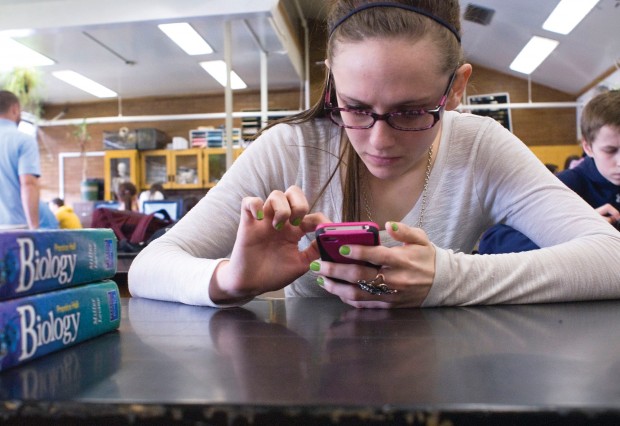
Technological
advancements are rapidly changing the way students use and interact with
educational materials. Students now have access to a range of electronic
devices that make learning more interactive, flexible and mobile. In the USA, a
national study of student use of technology found that students are drawn to and
recognise the benefits of technologies and prefer classes with online
components. In Australia, the DEEWR Digital Education Advisory Group forecast that due to the rapid uptake of
smart devices by students, teaching and learning settings are moving to a
‘bring your own device’ environment, where the choice of technology is
paramount.
While
undergraduate science curricula present text-based learning materials to
students predominantly in hard copy formats, the increased affordability,
functionality and portability of electronic devices calls for evaluation of
more technologically “savvy” ways to deliver these materials. Electronic
notebooks, or e-Manuals, may be one such means. Depending on the
software and device, an e-Manual can facilitate online submission of
assignments, provide direct access to ‘authentic’ internet materials, enable
integration of multimedia files and permit digital inking for drawings and
figures. Furthermore, e-Manuals have the added advantage of allowing staff to
update and add to learning materials in real-time, as well as reducing both
printing and environmental costs.
Another concern raised by students was the potential for damage to personal electronic devices during practical sessions by exposure to laboratory chemicals or breakage due to physical impact. Despite this misgiving, it is envisaged that such events would be no more common than with regular use outside the learning environment, due to strict safety protocols already in place. Protective covers could be added to further reduce such risks. Potential loss of data resulting from such events may be mitigated by ensuring that students regularly back up electronic data, either to a portable storage device or cloud-based storage system.
Read More
 |
| Photo credit: https://www.flickr.com/photos/johanl/ |
Despite
the potential advantages of using e-Manuals in education, there have been only
a few isolated efforts to integrate electronic devices across several domains,
including food chemistry, education, and chemistry
research. Furthermore, very little has been reported on student perceptions
of their readiness to utilise such platforms, or concerns they may have about
the viability of e-Manuals for practical activities.
 |
| Photo credit: https://www.flickr.com/photos/snre/ |
Device use and ownership
First
year biology students were surveyed at commencement of their degree studies
about ownership and confidence in using personal computers, including desktops,
laptops, tablets and smartphones. The majority of students (57%, n=1209) agreed or strongly agreed with
the statement “I feel confident enough to use my mobile device to write up my
practicals directly into an e-Manual”. Yet despite this indicated confidence,
half of the students agreed or strongly agreed that an e-Manual would be “more
difficult to use than a printed manual”.
Furthermore, although e-Manuals provide many additional features when
compared to hardcopy formats, most students were either ambivalent or thought that
an e-Manual would not enhance the learning process (neutral - 54%, disagree-strongly
disagree - 33%).
Hardcopy
vs Electronic use: A disconnect
Student
reluctance to engage with the e-Manual is likely due to the disconnect in the
use of hardcopy versus electronic devices within the practical environment.
Learning is facilitated by active reading, which involves the physical
manipulation of text by way of writing, annotating, and/or drawing. While
personal computers, in particular tablet devices, attempt to replicate these
processes they are not yet as efficient or user-friendly. Students commonly
undertake many active reading strategies during practical activities and this
may be the preferred way for them to support their learning. The use of an
e-Manual for reading information, following instructions and gathering data
runs into issues with syntopical reading, which involves simultaneous use of
more than one document or page. In
addition, inking tools for writing and drawing remain inefficient and awkward,
and do not adequately mimic the experience of drawing on paper.
 |
| Image credit: http://en.wikipedia.org/wiki/Science |
Another concern raised by students was the potential for damage to personal electronic devices during practical sessions by exposure to laboratory chemicals or breakage due to physical impact. Despite this misgiving, it is envisaged that such events would be no more common than with regular use outside the learning environment, due to strict safety protocols already in place. Protective covers could be added to further reduce such risks. Potential loss of data resulting from such events may be mitigated by ensuring that students regularly back up electronic data, either to a portable storage device or cloud-based storage system.
Software availability
At
the commencement of this project in mid-2013, an educational technologist was
employed to conduct a full market analysis of the software available to support an e-Manual. Despite an
extensive analysis, there does not appear to be software currently on the
market that fulfils our requirements. These include accurate replication of a
paper-based practical manual, with other key criteria being digital inking,
text entry, online submission, and integration of multimedia and internet
content. Until such software becomes available, students will quite
understandably continue to have misgivings about the advantages of using
e-Manuals.
Facilitating change for students and staff
It
is inherently clear that the transition from hardcopy to electronic learning
formats requires a carefully planned management strategy that encourages and
supports both students and staff in the transition process. When experiencing
change, it is not the change itself that takes people out of their comfort
zone, but rather the loss of something that is closely held and viewed as
important, that can create discontent. In the instance of
transitioning to an e-Manual, it seems that the ease, nostalgia and comfort of
using paper to read, take notes and draw may be the biggest
hurdle for students.
To
navigate the period of disequilibrium during the transition phase to an
e-Manual, it is essential that academic and teaching managers have the
resources to support tutors and students. This support should involve
additional training for tutors and subsequent coaching and technical support
for students. It is also crucial that alternative methods to mitigate the
experience of loss are identified. For instance, students not wishing to use
aspects of an e-Manual (e.g. the desire to continue to draw diagrams on paper)
are shown alternatives during the interim (e.g. taking photo of drawn diagram
and inserting it into the e-Manual).
Once
the obstacles that make students reluctant to use technology for practical activities
are removed or overcome, the value of e-Manuals for such modes of learning may
be more fully realised.
Acknowledgments
Funding
for this project has been provided by the Australian Government Office for
Learning and Teaching. The views expressed in this report do not necessarily
reflect the views of the Australian Government Office for Learning and
Teaching.
Aspects of this project were also funded by the Monash University Science Faculty Teaching Innovation Fund and this work was conducted by the authors in collaboration with Bruce Weir, Simon Clarke and Chris Thompson
Aspects of this project were also funded by the Monash University Science Faculty Teaching Innovation Fund and this work was conducted by the authors in collaboration with Bruce Weir, Simon Clarke and Chris Thompson
This is an edited copy of a recently published report for the Higher Education Research and Development Society of Australasia (HERDSA) news (2014, 36, 24-25). The report was written by Dr Sherrie Caarels, Dr Gerry Rayner and Dr Rowan Brookes, in the School of Biological Sciences.